
I don’t always take hostages, but when I do,
I annoy a real bad-ass
Bullies are also cowards. This truism was exemplified by the Obama administration. At home, it used the Internal Revenue Service to deny tax exemptions to conservative organizations, thus impairing their ability to receive donations. And it used the National Security Agency to spy on political opponents. The full extent of this bullying has yet to be made public.
But abroad, the Obama administration behaved obsequiously with hostile foreign leaders, while it went out of its way to irritate friends. Remember Obama’s behavior with King Abdullah of Saudi Arabia? This man rules a nation that presents itself as our ally, but at the same time approves of terrorism and spends millions to fund radical mosques, run by imams who often preach terrorism and murder of “infidels.” Yet our president showed him not just respect but obeisance.

Remember Obama’s behavior with Emperor Akihito of Japan? The emperor is the titular head of a friendly nation. But why must our president bow to him?

President Obama was both chief of state (equivalent to a king) and head of government (equivalent to a prime minister). As such, he should greet foreign leaders with respect, but as equals − which they are, according to official protocol.
These are blatant examples, but hardly the only ones. Remember Obama’s affectionate handshake with the late “President” Hugo Chavez of Venezuela?

While not as disgraceful as a bow, this warm greeting of an anti-American enemy of freedom symbolizes the direction of our government: Be submissive to those who show us hostility, but be hostile to those who have a record of being our friends.
Is this judgment too harsh? Consider the administration’s repeated, almost pathetic attempts to befriend the leaders of Iran. They openly declared their intention to wipe Israel off the map, while also making thinly veiled threats to American troops in the region, and at the same time defying the “international community” by preparing to construct nuclear weapons.
Unstable fanatics caused the administration only mild unease. But what caused acute anxiety? The Israelis decided to build 1600 homes in East Jerusalem, and Secretary of State Hillary Clinton had a meltdown. Build nuclear weapons? Let’s talk. But build houses? Intolerable! If you want an illustration of a cowardly bully, look no further.
Nor is this the only example of hostility toward our friends. Consider Obama’s repeated snubs of Gordon Brown, then prime minister of the United Kingdom, our ally in two World Wars and our staunchest ally in the war on terror.
And consider Obama’s reneging on the promise of a missile defense for Poland and the Czech Republic, our friends in Eastern Europe. Who could have blamed our friends for concluding that they were our former friends, and looking elsewhere for friendship?
Added to the Obama administration’s deteriorating relationship with Israel, the anti-British turn in our foreign policy could be seen as punishing friends while rewarding enemies. This is a sure recipe for having fewer friends and more enemies. How could intelligent, educated people not see this? Perhaps because their education was laced with large doses of “blame America first.” If we are responsible for most of the ills of the world, the solution is to reverse course − oppose our friends and befriend our enemies.
But did our enemies befriend us? Did Iran respond to our repeated overtures by dismantling its nuclear facilities and renouncing its hostile intentions? Did Venezuela turn toward a pro-freedom, pro-United States policy? Did Saudi Arabia cease funding the instigation of terrorism? Are you joking?
People with even a rudimentary knowledge of history know that a submissive attitude will not evoke goodwill from our enemies − it will evoke only contempt and increased hostility. Most educated people regard the words “Chamberlain,” “Munich,” and “appeasement” with distaste, even revulsion. But to the anti-American Left, these words represent a policy that should be tried again − maybe this time it will work better. It won’t.
The difference is that last time, our enemies needed ships, planes, and armies to attack us. This time, they can use suicide bombers, aircraft hijackers, missiles, and ultimately nuclear, biological, and chemical weapons. This time, our oceans cannot protect us. This time, we do not have months or years to awake from our pacifist slumber.
To top things off, President Obama and Secretary of State Hillary Clinton denied repeated requests for more security by Chris Stevens, our ambassador in Libya. And then, when our consulate in Benghazi was under attack, they did not even attempt a rescue. What message did this send to friends and enemies alike?
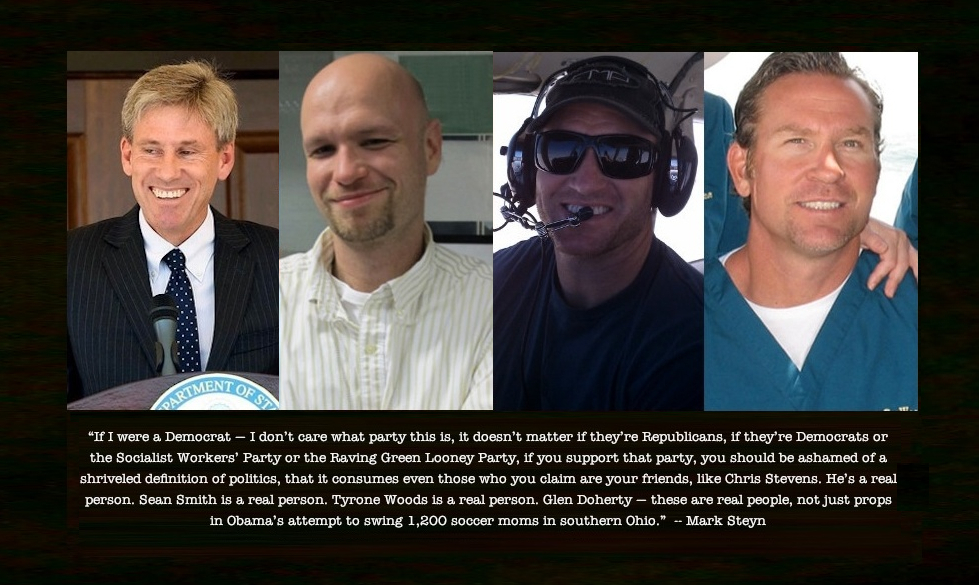
On the left is Ambassador Chris Stevens. Then we have State Department Information Officer Sean Smith, and former SEALs Glen Doherty and Tyrone Woods. The last two were contractors who were in Benghazi on another mission, and – typically – rushed to help when they heard the consulate was in trouble.
It wasn’t a “spontaneous demonstration.” Demonstrators go around with placards, not mortars, machine guns, and rocket-propelled grenades. But Obama and Clinton blamed an obscure Internet video and hesitated to use the word “terrorism.” That is:
(1) Refuse more security.
(2) Don’t send a rescue party.
(3) Fob off responsibility.
(4) Fabricate an excuse.
(5) Claim it’s old news: “What difference, at this point, does it make?”
(6) Deny it happened: “We didn’t lose a single person” in Libya.
Obama said his administration would “lead from behind.” We just didn’t know how far behind.
So there you have it: Bow to the strong, be aggressive to the weak. Grovel before enemies, turn our back on friends. Would you respect a person who behaved like that? Then why do you think the world would respect a nation that behaved like that?
Recently I passed a young man in the mall. He looked fit and had a “high and tight” haircut. He wore an olive green T-shirt. The wording caught my eye:
Mess with the best
Die like the rest
Though the words were a bit crude, they conveyed the basic idea of the war on terror. But for the eight years of the Obama administration, that shirt was out of style. It was time for another T-shirt, one that more accurately reflected the situation at that time:
If you put us to the test
We’ll desert you like the rest
Of course, this shirt would be offered only in yellow, definitely not in olive green.
Well, which T-shirt would you wear? And don’t tell me you would wear another color, or that you don’t wear T-shirts at all. In dangerous times, we all must choose. I prefer the olive green version. Best of all, it’s back in style.
●
Author’s Note: The photo at the top of this column is of actor Rade Šerbedžija, who played the villain in the film “Taken 2.” His character was the antagonist of the hero, played by Liam Neeson. He bears a striking resemblance to Jonathan Goldsmith, who was the man in the Dos Equis beer commercials who said, “I don’t always…but when I do…”
My compliments to both gentlemen for involuntarily helping me to make my point: Hostage-taking specifically, terrorism more generally, and bullying in any form, are not inhibited by talking, or consulting, or appeasing ‒ but by the biggest kid in the schoolyard giving the bully a good smack. This doesn’t accord with progressive theory. It merely accords with reality.
●
Contact: dstol@prodigy.net. You are welcome to publish or post these articles, provided that you cite the author and website.